1) Turn off the water supply to your shower.
A worn-out rubber washer could also be the cause of a leaky shower head. The washer or “O ring” can begin to crack over time and allow water to seep through. You can solve this problem simply by replacing the washer. To do this, start by cutting off the water supply to your bathroom, which can be found near your shower or in your basement.
a. You can maintain these rings by applying lubricant
b. If you have a compression faucet, meaning two different faucet handles to control the hot and cold water, you will need to put your hand underneath to determine if the leak is coming from the hot-water valve or the cold-water valve. By doing this, you can know which faucet you need to focus on.
2) Determine which rubber washer you should replace
There are two rubber washers you can decide to replace: the one in your shower head or the one in your shower faucet. Also, your shower faucet type will determine the type of rubber washer you need to replace. A compression faucet (or a two-handle faucet) will require replacing the rubber washer in the faucet. However, for a single-handle faucet, you might likely need to change the rubber washer inside the showerhead.
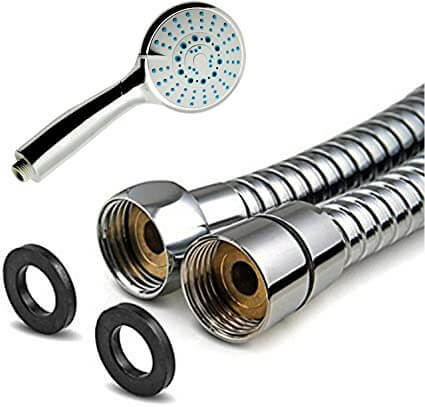
3) Replace the rubber washer in your shower head
Start by taking the showerhead apart. The method used in doing this will depend on the make and brand of the showerhead, but usually, you will find a collar nut attached to the shower arm. The collar nut has the look of a regular metal nut, but it is longer. Its neck (or collar) is about 1.5 times its diameter.
1. Hold the fixture down with a rag and use a wrench to loosen the collar nut so that the showerhead is separated from the shower arm. When this is done, look underneath the shower head’s swivel, and you will find the rubber washer.
2. The swivel ball is a metal fixture that is directly attached to the showerhead, and it allows the movement of the showerhead. It is a metal fixture that looks like a big nut with a metal ball on the end. It can also be rotated like a showerhead.
3. After you have found the rubber washer, you can then replace it with a new rubber washer, similar in style and size. A perfect replacement is one that has a striking resemblance to the old one. Also, the new washer should have the same thickness to prevent leaking over time.
4) Replace the rubber washer in your faucet
Remove the faucet handle by unscrewing it. You can determine the faucet you should be working on by studying the temperature of the leaking water.
1. This screw might be easy to see or hidden behind a cover cap, depending on the make and brand of your faucet. Older model faucets usually have these screws exposed on the side or front of your faucet, while newer models usually require that you lift the cover cap to expose the screw.
2. When you have removed this screw, you can proceed to pull it off the faucet body by pulling the handle hard. To do this, you may need a faucet puller. After taking the handle off, remove the trim and sleeve that covers the faucet stem, after which you use a deep socket to unscrew the faucet stem. A hex nut holds down the faucet stem, so a deep socket will be needed to unscrew the hex nut. The hex nut is a nut with six sides, and a shower valve socket wrench can easily loosen it.
3. When all this is done, you can replace the rubber washer. If you’ve bought the faucet washer kit, you can also replace the flat washer at the end of the stem and the seals.
5) Reassemble the shower parts and check to see if the problem’s fixed.
After you have changed the rubber washer in the showerhead, connect the showerhead back to the shower arm and put on the water supply again so that you can see if the problem has been taken care of. Don’t try to overtighten the showerhead, just screw it on snugly.
After changing the rubber washer in the shower faucet, you should put your faucet back together, starting from the faucet stem. Apply some plumber’s grease on the threads where the stem will go and screw the stem back on. Replace the handle to its original position, but don’t screw until you are sure that the leaking shower head has been fixed after you have turned your water supply back on.

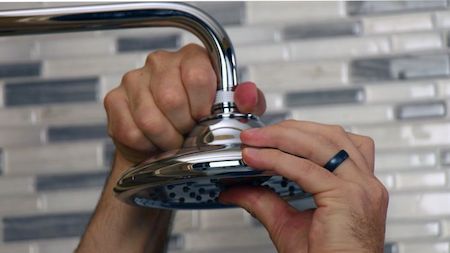 Cut off the water supply to your shower head. Start by putting off the shower at the knob for inspection or replacement. Mineral deposits like lime can gather and clog the holes, causing a leaky shower head. This is the best place to start if you aren’t sure of what is making your showerhead leak. It costs nothing to do, and you don’t have to dismantle your entire shower fixture to do it.
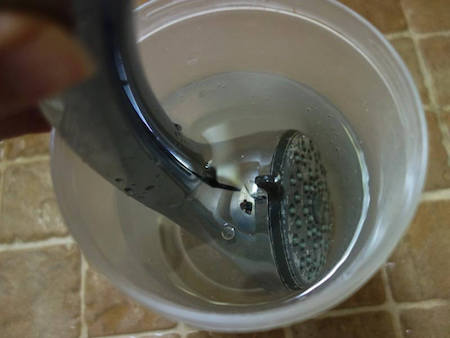 Get a bowl, basin or bucket big enough to contain the faceplate or showerhead. A bathroom sink can also work perfectly well if it is large enough to hold the showerhead and if it is not in use.
Plug the sink to ensure no liquid escapes and fill it (or the container) with white vinegar and some coarse salt. Put enough vinegar to cover the faceplate or showerhead fully.
Leave the showerhead or faceplate in the container or sink of vinegar for at least 8 hours. This will help in dissolving the mineral deposits and buildup.
Get a bowl, basin or bucket big enough to contain the faceplate or showerhead. A bathroom sink can also work perfectly well if it is large enough to hold the showerhead and if it is not in use.
Plug the sink to ensure no liquid escapes and fill it (or the container) with white vinegar and some coarse salt. Put enough vinegar to cover the faceplate or showerhead fully.
Leave the showerhead or faceplate in the container or sink of vinegar for at least 8 hours. This will help in dissolving the mineral deposits and buildup.
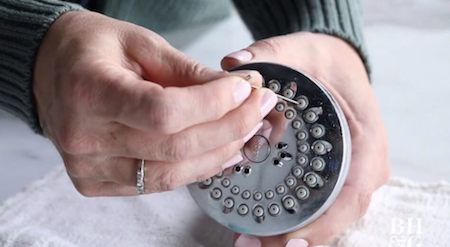 After soaking for 8 hours, the white vinegar would have done its job and dissolved the lime and other mineral deposits. Remove it from the container and find a toothpick or any other thin object that can fit in the holes of the showerhead. Stick this thin object into each of the showerhead holes so that the debris can come off. Afterwards, scrub the faceplate clean with a stiff plastic brush.
An air compressor can also be used to blow out the debris gently.
After soaking for 8 hours, the white vinegar would have done its job and dissolved the lime and other mineral deposits. Remove it from the container and find a toothpick or any other thin object that can fit in the holes of the showerhead. Stick this thin object into each of the showerhead holes so that the debris can come off. Afterwards, scrub the faceplate clean with a stiff plastic brush.
An air compressor can also be used to blow out the debris gently.
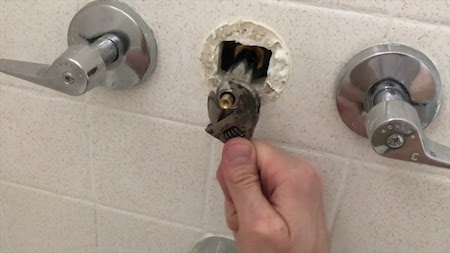 1) Turn off the water supply to your bathroom
As usual, start by shutting off the water supply by turning off the valve to the bathroom or the entire home’s main supply. A diverter valve has a main purpose: switch the water from the bathtub faucet to the showerhead. Due to the passage of time, this valve can become weaker and clogged up due to the buildup of sediments. When a diverter valve is faulty, it will leak even when water should be allowed to flow through the bathtub faucet. A faulty diverter valve can be fixed by cleaning, but most times, it’s better to replace it.
2) Unscrew and remove the faucet handle to expose the diverter valve
Find the screw to the faucet handle, which is either exposed openly or hidden under a cap. If it is hidden under a cap, remove the cap with a tiny pocket knife.
3) Take out the diverter valve
Removing the diverter valve involves separating the valve assembly from the hex nut on the faucet stem by unscrewing it. If you find it difficult to do, get a vinegar-soaked rag and wrap it around the components for a short period to clear up any limescale present. You can also use WD-40.
4) Clean the diverter valve or replace it
When you have unscrewed the diverter valve, you can now clean it up using a small stiff wire brush along with white vinegar. Also, check for sediment buildup and wear and tear in the diverter valve. When you have confirmed that there is none, leave the valve to sit out to dry. You might have to replace the valve assembly if you see any cracks on the diverter valve.
5) Reassemble the faucet handle and determine if the leaking shower head is fixed.
Do all the previous steps in reverse to reassemble the faucet handle. Turn on the water supply to see if the showerhead is now fixed before you screw it back on.
1) Turn off the water supply to your bathroom
As usual, start by shutting off the water supply by turning off the valve to the bathroom or the entire home’s main supply. A diverter valve has a main purpose: switch the water from the bathtub faucet to the showerhead. Due to the passage of time, this valve can become weaker and clogged up due to the buildup of sediments. When a diverter valve is faulty, it will leak even when water should be allowed to flow through the bathtub faucet. A faulty diverter valve can be fixed by cleaning, but most times, it’s better to replace it.
2) Unscrew and remove the faucet handle to expose the diverter valve
Find the screw to the faucet handle, which is either exposed openly or hidden under a cap. If it is hidden under a cap, remove the cap with a tiny pocket knife.
3) Take out the diverter valve
Removing the diverter valve involves separating the valve assembly from the hex nut on the faucet stem by unscrewing it. If you find it difficult to do, get a vinegar-soaked rag and wrap it around the components for a short period to clear up any limescale present. You can also use WD-40.
4) Clean the diverter valve or replace it
When you have unscrewed the diverter valve, you can now clean it up using a small stiff wire brush along with white vinegar. Also, check for sediment buildup and wear and tear in the diverter valve. When you have confirmed that there is none, leave the valve to sit out to dry. You might have to replace the valve assembly if you see any cracks on the diverter valve.
5) Reassemble the faucet handle and determine if the leaking shower head is fixed.
Do all the previous steps in reverse to reassemble the faucet handle. Turn on the water supply to see if the showerhead is now fixed before you screw it back on.
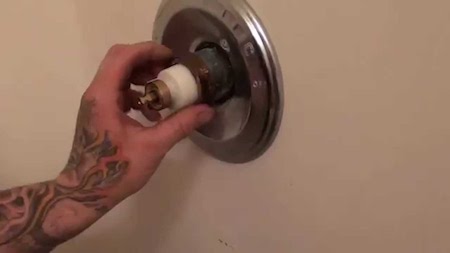 3) Remove and replace the cartridge.
Depending on the manufacture, there are different methods you can use to remove the cartridge. A newly purchased cartridge might come with a cartridge removal cap. Typically, when removing the cartridge, you should try to unscrew the hex nut covering the cartridge stem, then untwist the cartridge stem and remove it with pliers.
3) Remove and replace the cartridge.
Depending on the manufacture, there are different methods you can use to remove the cartridge. A newly purchased cartridge might come with a cartridge removal cap. Typically, when removing the cartridge, you should try to unscrew the hex nut covering the cartridge stem, then untwist the cartridge stem and remove it with pliers.